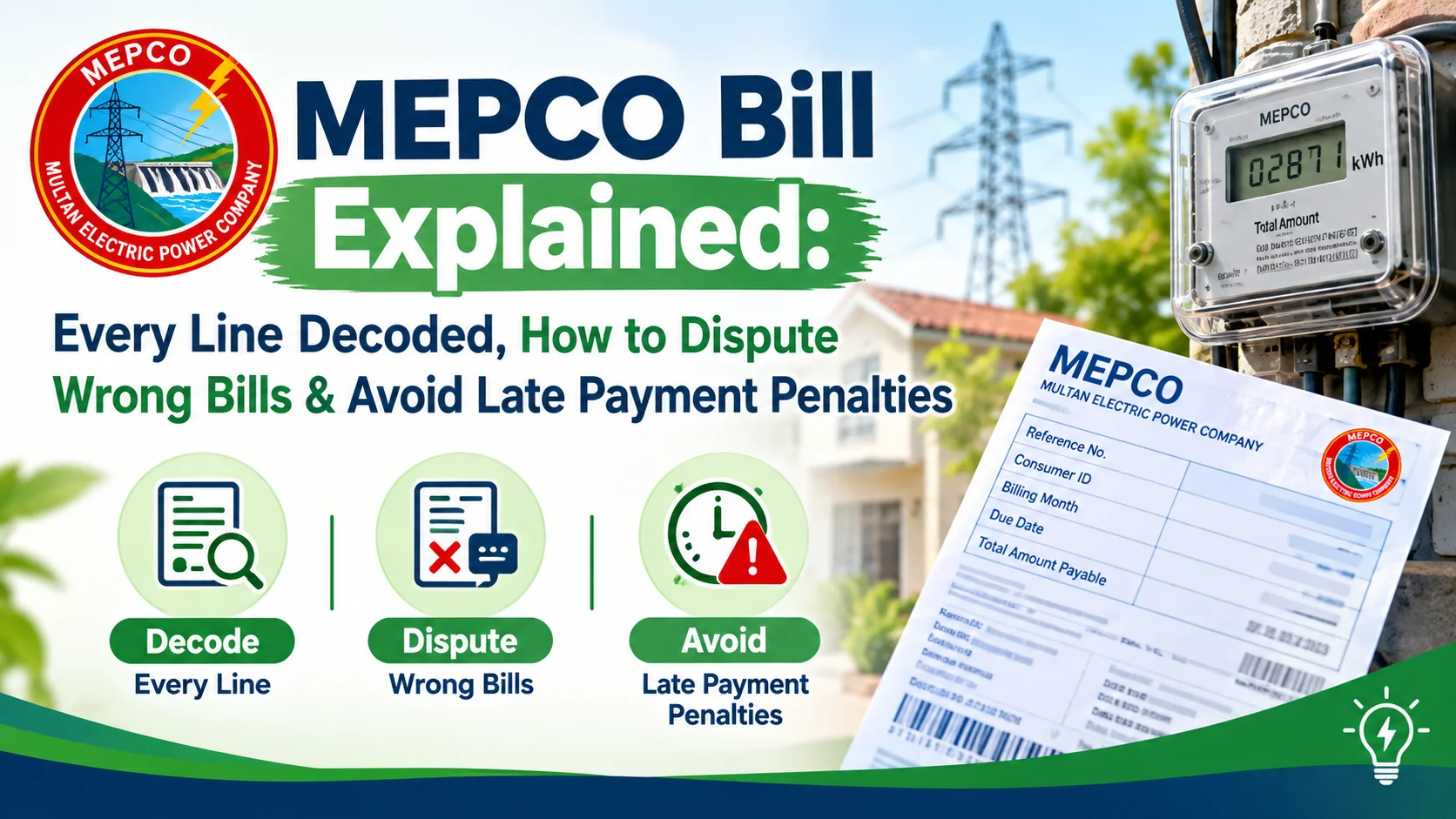
MEPCO Bill Explained: Every Line Decoded, How to Dispute Wrong Bills & Avoid Late Payment Penalties
What is the Mepco bill?
A MEPCO bill is the official electricity statement issued by Multan Electric Power Company to consumers across 13 districts of South Punjab, showing units consumed, tariff charges, and payment deadlines. Households in Multan, Bahawalpur, Rahim Yar Khan, and nearby districts often find the bill confusing, especially when a wrong reading or sudden spike appears. This breakdown decodes every line and shows the exact steps to dispute an incorrect charge.
What Is MEPCO and Where Does It Operate?
MEPCO — Multan Electric Power Company — is a government-owned electricity distribution company operating under the Ministry of Energy (Power Division), Government of Pakistan. It is regulated by NEPRA (National Electric Power Regulatory Authority).
MEPCO is responsible for electricity distribution across 13 districts of South Punjab:
| District | District | District |
| Multan | Bahawalpur | Rahim Yar Khan |
| Dera Ghazi Khan | Sahiwal | Pakpattan |
| Khanewal | Lodhran | Vehari |
| Muzaffargarh | Rajanpur | Layyah |
| Bahawalnagar |
Source: MEPCO official website — mepco.com.pk
According to MEPCO’s publicly reported figures, the company serves one of the largest consumer bases of any distribution company (DISCO) in Pakistan.
Every Line on Your MEPCO Bill — Fully Explained
The following explanations are based on the standard MEPCO residential bill format as publicly issued. If your bill layout differs slightly, the field names remain consistent.
1. Consumer Name & Address
Your registered name and connection address as held in MEPCO’s system. Errors here are corrected at your local MEPCO Sub-Division Office with your original CNIC and a written application.
2. Reference Number (14 Digits)
Your connection’s unique identifier within MEPCO’s billing system. This number is required for every interaction — online bill checking, bank payment, complaint registration, and meter-related requests. Keep it saved somewhere accessible.
3. Tariff Code
NEPRA assigns tariff categories to all consumers. The categories most commonly seen on MEPCO residential and small commercial bills are:
| Tariff Code | Connection Type |
| A-1 | Domestic residential (up to 5 kW sanctioned load) |
| A-1(a) | Domestic residential (above 5 kW sanctioned load) |
| A-2 | Commercial |
| B-1 | Small industrial |
| D-1 | Agricultural / Tube well |
Source: NEPRA Schedule of Tariffs — nepra.org.pk
The vast majority of households in South Punjab fall under A-1. If your bill shows any other code and you believe it is incorrect, visit your Sub-Division Office with your CNIC and connection documents.
4. Billing Month
The billing period covered by this bill. MEPCO operates on a bi-monthly billing cycle for most domestic consumers, meaning each bill covers approximately 60 days of consumption.
5. Present Reading / Previous Reading / Units Consumed
| Reading Field | Meaning |
| Present Reading | Meter reading recorded during the most recent meter reader visit |
| Previous Reading | Reading recorded during the previous billing cycle |
| Units Consumed | Present Reading minus Previous Reading = kWh consumed this period |
What “EST” means on your MEPCO bill:
If the reading is marked EST, the billing was based on an estimated figure — the meter reader did not physically read your meter. Estimated bills are permitted under MEPCO procedure when a meter is inaccessible, but they must be corrected against an actual reading in the following cycle. If your EST-marked bill shows an unusually high figure, you have grounds to formally request a meter re-reading.
6. Units Consumed
This is the single most consequential number on your entire bill. It directly determines which tariff slab applies and therefore the total amount payable. Every other charge is calculated from or in addition to this figure.
7. Payable Within Due Date
The total amount due if paid on or before the printed due date. This is the amount to use for all payment purposes.
8. Payable After Due Date
The amount payable if the due date is missed. This higher figure includes a Late Payment Surcharge (LPS). NEPRA regulations permit DISCOs including MEPCO to apply LPS on overdue bills. The applicable LPS rate is set by NEPRA and reflected in current tariff determinations published on nepra.org.pk.
Important: Do not rely on informal estimates of the LPS percentage — the rate is subject to revision by NEPRA. Your bill itself always shows the exact Payable After Due Date figure.
9. Due Date
The payment deadline printed on your bill. Paying on the due date itself carries a small risk of processing delays at the bank or payment platform. Paying one working day before the due date eliminates that risk entirely.
10. Arrears
Outstanding balance from one or more previous billing periods that remains unpaid. Persistent arrears are the most common reason for disconnection notices. If you believe arrears on your bill are incorrect — for example, if you paid but the payment was not reflected — your bank payment receipt is the document to present at your Sub-Division Office.
11. Taxes & Surcharges — What Each One Means
These charges are determined by the federal and provincial governments and by NEPRA. They are not set by MEPCO. The following descriptions are based on publicly available regulatory documentation:
| Charge | What It Is | Set By |
| GST (General Sales Tax) | Federal sales tax applied to electricity consumption under the Sales Tax Act | Federal Government |
| FC Surcharge | Federal Conservation Surcharge — rate and applicability set by federal government | Federal Government |
| FPA (Fuel Price Adjustment) | Monthly adjustment reflecting changes in actual fuel costs for power generation — can be positive or negative | NEPRA (monthly) |
| QTA (Quarterly Tariff Adjustment) | Quarterly reconciliation of estimated vs actual generation costs | NEPRA (quarterly) |
| Electricity Duty | Provincial tax on electricity consumption | Punjab Government |
| TV Licence Fee | PTV fee applied to all consumer bills by law | Federal Government |
| Neelum-Jhelum Surcharge (NJS) | Funds Neelum-Jhelum Hydropower Project debt obligations | Federal Government |
Source: NEPRA monthly and quarterly determination notices — nepra.org.pk
None of these charges are negotiable or disputable at the consumer level — they are applied uniformly per regulatory instruction. However, if a charge appears on your bill that does not correspond to any known regulatory surcharge, that is a legitimate basis for formal inquiry.
12. Protected vs Non-Protected Status
| Status | Condition | Tariff Applied |
| Protected | 300 units or fewer consumed in the billing period | Subsidised lower tariff |
| Non-Protected | More than 300 units consumed in the billing period | Standard higher tariff — applies to entire bill |
The threshold effect — this is critical:
Under the slab system, crossing the 300-unit threshold does not mean only the excess units are charged at the higher rate. The applicable rate structure changes for the entire consumption figure. This is why a small increase in consumption near the threshold can produce a disproportionately large increase in your total bill amount.
Source: NEPRA Schedule of Electricity Tariffs for Domestic Consumers — nepra.org.pk
What to Do When Your MEPCO Bill Is Wrong
Situations That Justify a Formal Complaint
| Situation | Action |
| Meter display shows lower reading than bill | Photograph meter, file correction complaint |
| Bill marked EST with unusually high figure | Request physical meter re-reading through 118 |
| Sharp consumption increase with no usage change | Check meter reading, compare to 2-3 previous bills |
| Unidentifiable charge not in NEPRA surcharge list | Request written explanation at Sub-Division Office |
Step One — Verify at the Meter
Before filing any complaint, physically read your meter and photograph the display. The photograph timestamp serves as your evidence. Compare the meter reading with the Present Reading on your bill. A documented discrepancy is the foundation of any successful complaint.
Step Two — File Through the Appropriate Channel
| Method | Contact | Best For |
| MEPCO Helpline | 118 (free, any network) | Immediate complaints, reading disputes |
| MEPCO WhatsApp | 0307-7848566 | Sending meter photos with Reference Number |
| Sub-Division Office | Your local office (in person) | Formal written complaints — most effective |
| NEPRA Helpline | 080025622 (toll-free) | Escalation if MEPCO unresolved after 14 days |
| NEPRA Online | nepra.org.pk/complaints | Formal written NEPRA escalation |
For Sub-Division Office visits, bring:
- Original CNIC and one photocopy
- Current bill — original or clear printout
- Bills from the previous two to three months
- Meter photograph (on your mobile)
Submit a written application requesting meter re-reading and bill correction. Request an acknowledgement stamp on your copy. This stamped copy is your proof that the complaint was formally received.
Should You Pay a Disputed Bill?
Yes — pay the undisputed portion before the due date. Withholding payment entirely while a complaint is pending does not protect you from LPS or disconnection under current MEPCO consumer service rules. Pay the amount you are confident is correct, document your complaint, and the difference will be adjusted in a subsequent bill once resolved.
Reducing Your Electricity Bill — Practical Guidance for South Punjab
| Action | Why It Works |
| Check meter at 30-day mark | Bills cover 60 days — mid-cycle checks give time to reduce consumption before the bill is generated |
| Set AC to 26°C instead of 22–24°C | Reduces compressor run time — documented energy efficiency principle |
| Switch to LED bulbs | Consume significantly less electricity than incandescent bulbs for equivalent output |
| Schedule heavy appliances in off-peak hours | Spreads load — washing machines, irons, water heaters are best run mid-morning or afternoon |
| Monitor the 300-unit threshold | Staying Protected vs going Non-Protected changes your entire bill’s rate calculation |
All recommendations above are based on general electrical efficiency principles. None are sponsored recommendations.
Frequently Asked Questions — MEPCO Bill
Final Word
Your MEPCO bill is a regulated document. Every charge on it has a legal basis, and every error on it has a correction process. Understanding it is not complicated once someone explains it clearly — which is exactly what this guide is for.
If a bill looks wrong, do not pay it silently. The complaint mechanisms exist, they are free to use, and they work when used correctly
About the Author
I have spent the last three years helping residents across South Punjab understand their MEPCO bills — in person, through community groups, and online. The single most common thing I hear is: “I just pay whatever is written. I don’t understand any of it.”
That stops today.
This guide is built entirely on publicly available MEPCO and NEPRA documentation, verified tariff schedules, and real questions asked by consumers in Multan, Bahawalpur, Rahim Yar Khan, and surrounding districts. Nothing here is guesswork.