MEPCO Bill Calculator 2026 How Your Electricity Bill Is Actually Calculated Pakistan?
If you’ve ever typed your units into a MEPCO bill calculator and gotten a number that doesn’t quite match the bill sitting in your hand, you’re not doing anything wrong — that gap is built into how MEPCO bills actually work. Between fuel price adjustments that shift every single month and a slab system that can silently double your per-unit rate once you cross a certain line, an estimate is exactly that: an estimate, not a mirror of your final invoice.
This guide breaks down the real formula MEPCO uses, walks through a full worked example with actual numbers, and covers one rule almost nobody warns you about — cross 200 units even once, and you can get stuck paying the higher rate for six months straight, even if your usage drops right back down the next month.
What a MEPCO Bill Calculator Actually Estimates?
A MEPCO bill calculator takes the one number you actually know — your units consumed — and runs it through the same tariff logic MEPCO itself uses, matching your consumption to the correct slab, then layering on fixed charges, fuel adjustments, and taxes.
What the Calculator Includes and What It Leaves Out?
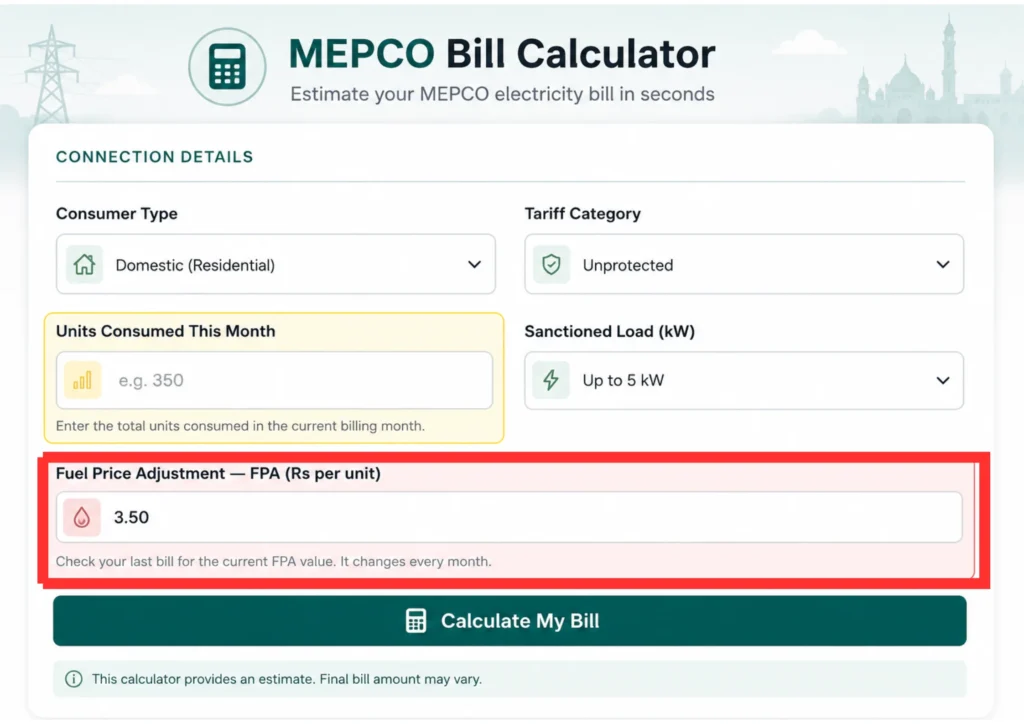
A good calculator includes your base energy charge (units × slab rate), the fixed monthly charge tied to your slab, an estimated Fuel Price Adjustment (FPA), General Sales Tax (GST), and Electricity Duty. What it typically can't include with certainty is the Quarterly Tariff Adjustment (only applied in specific months), any outstanding arrears from a MEPCO previous bill that are unpaid, and withholding tax if you're above the applicable threshold — all of which depend on account-specific data the calculator doesn't have access to.
Why It's Called an Estimate, Not Your Exact Bill?
NEPRA notifies the FPA figure monthly, and that number is often not finalized until close to your billing date — meaning any calculator run earlier in the month is working with a placeholder rather than the actual confirmed rate. Combine that with possible arrears or an estimated (not physically read) meter, and a small gap between the calculator's output and your real bill is normal, not a sign the tool is broken.
The Full MEPCO Bill Formula
The Full MEPCO Bill Formula
Here is the complete calculation, stated in full so it doesn't need repeating anywhere else in this guide:
Total Bill = (Units × Applicable Slab Rate) + Fixed Monthly Charge + Meter Rent + Fuel Price Adjustment (FPA) + FC Surcharge + NJ Surcharge + Quarterly Tariff Adjustment (if applicable that month) + Electricity Duty + General Sales Tax + TV Fee + Withholding Tax (if applicable)
Every one of these components is explained individually further down this guide — this section exists so you have the full picture in one place before we break it apart piece by piece.
Which Charges Apply Every Month vs Only Sometimes?
|
Charge |
Applies |
|---|---|
|
Energy charge (units × slab rate) |
Every month |
|
Fixed monthly charge |
Every month |
|
Meter rent |
Every month |
|
FPA |
Every month, amount varies |
|
FC Surcharge |
Every month, fixed per-unit rate |
|
NJ Surcharge |
Every month, fixed per-unit rate |
|
Electricity Duty |
Every month |
|
GST |
Every month |
|
TV Fee |
Every month, fixed amount |
|
Quarterly Tariff Adjustment (QTA) |
Only March, June, September, December |
|
Withholding Tax |
Only if consumption exceeds the applicable threshold |
MEPCO Residential Tariff Slabs 2026
Protected Consumer Rates (Up to 200 Units)
If your monthly consumption stays at or below 200 units, MEPCO classifies you as a "Protected Consumer" and charges a subsidized rate, roughly in the range of Rs. 3.95 to Rs. 10 per unit depending on exactly where in that range your consumption falls. This is the cheapest slab available to residential consumers.
Non-Protected Consumer Rates (Above 200 Units)
Once you exceed 200 units in a month, you move into the non-protected category, where rates start around Rs. 22 to Rs. 30 per unit and can climb past Rs. 28.50 to Rs. 32+ per unit for consumption above 700 units. The jump between the top of the protected slab and the bottom of the non-protected slab is significant — which is exactly why the next section matters so much.
The 200-Unit Slab Trap Almost Nobody Warns You About
How Crossing 200 Units Once Locks You In?
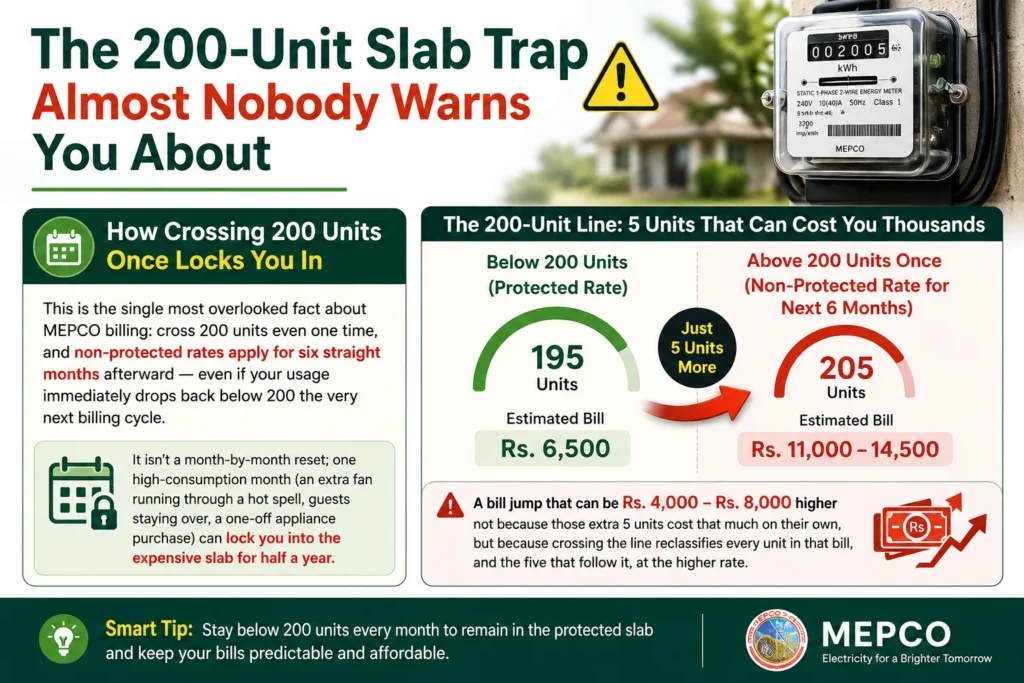
This is the single most overlooked fact about MEPCO billing: cross 200 units even one time, and non-protected rates apply for six straight months afterward — even if your usage immediately drops back below 200 the very next billing cycle. It isn't a month-by-month reset; one high-consumption month (an extra fan running through a hot spell, guests staying over, a one-off appliance purchase) can lock you into the expensive slab for half a year.
Practically, this means a household sitting at 195 units is only 5 units away from a bill jump that can realistically run from Rs. 4,000 to Rs. 8,000 higher than expected — not because those extra 5 units cost that much on their own, but because crossing the line reclassifies every unit in that bill, and the five that follow it, at the higher rate.
How to Stay Safely Under the Slab Boundary?
Watching consumption closely in the final week of your billing cycle is the most practical safeguard, since that's typically when a household is closest to the edge without realizing it. Energy-efficient appliances and simply being aware of the 200-unit ceiling — rather than only checking your bill after the fact — are the two things that actually keep you inside the protected bracket.
MEPCO Commercial and Industrial Rates
How Commercial Rates Differ From Residential?
Commercial connections don't get access to the protected-consumer discount at all. Rates for commercial users generally start around Rs. 22 per unit and can exceed Rs. 32 per unit for businesses with high consumption — closer to the non-protected residential rate from the outset, regardless of how low a given month's usage happens to be.
Industrial and Agricultural Tariff Notes
Industrial connections are billed under their own separate tariff structure, generally at rates higher than standard residential slabs. Agricultural tariffs are also distinct from domestic rates and are calculated under a separate NEPRA-approved structure entirely — if you're on an agricultural tubewell connection, the residential slab table above does not apply to you.
Step by Step — Calculate Your Own Bill Manually
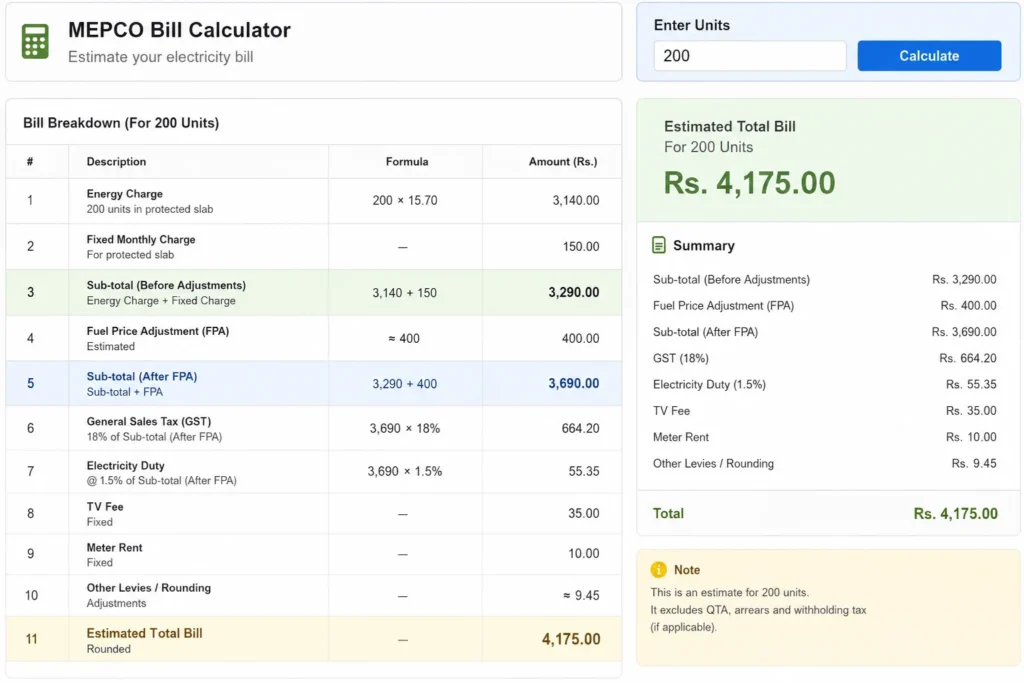
Worked Example With Real Numbers
Here's a full walkthrough using 200 units as the example, so you can see exactly how each formula component stacks:
- Energy charge: 200 units within the protected slab, producing a base energy cost
- Sub-total before adjustments: roughly Rs. 3,450 at this consumption level
- Fuel Price Adjustment: approximately Rs. 400 added on top
- GST at 18%: applied to the adjusted sub-total, approximately Rs. 621
- Electricity Duty and other levies: approximately Rs. 104
- Estimated total bill: roughly Rs. 4,175 for 200 units
This example excludes the TV Fee, meter rent, and any quarter-specific QTA charge, since those add a comparatively small, fairly fixed amount on top regardless of your consumption level.
How to Adjust the Example for Your Own Units?
To adapt this for your own bill, start by identifying which slab your unit count falls into (protected vs non-protected), multiply your units by that slab's per-unit rate to get your energy charge, then add the fixed monthly charge and meter rent for your connection type.
From there, layer on the FPA figure for the current month (check NEPRA's latest announcement rather than assuming last month's figure still applies), then apply GST and Electricity Duty on top of that running total. Add the TV Fee, and if you're checking a bill from March, June, September, or December, factor in the Quarterly Tariff Adjustment as well.
Understanding FPA, Surcharges, and Quarterly Adjustments
Fuel Price Adjustment (FPA)
The FPA is a per-unit charge that reflects the actual monthly cost of fuel used in power generation nationally, and NEPRA announces this figure fresh every month. This is the single biggest reason your bill amount shifts from month to month even when your consumption stays exactly the same — it isn't a MEPCO-specific decision, it's a national fuel-cost pass-through applied across all NEPRA-regulated distribution companies.
FC Surcharge and NJ Surcharge
The FC Surcharge is a fixed 43 paisa per unit charge that goes toward repaying Power Holding Private Limited's debt. The NJ Surcharge is a separate fixed per-unit levy specifically tied to funding the Neelum Jhelum Hydropower Project's debt obligations. Both are applied consistently every month regardless of season or consumption level, unlike the FPA which fluctuates.
Quarterly Tariff Adjustment (QTA) — March, June, September, December
Unlike FPA, FC Surcharge, and NJ Surcharge, which appear every single month, the Quarterly Tariff Adjustment is only applied in four specific billing months: March, June, September, and December. If you're calculating or comparing bills outside of these four months, you can leave QTA out of your estimate entirely — it simply doesn't apply that cycle.
Taxes on Your Bill
GST and Electricity Duty
General Sales Tax is applied to your electricity charges at 18%, calculated on the sub-total after energy charges and surcharges have been added. Electricity Duty is a separate government levy, applied at a smaller percentage on top of your base charges — both are standard, non-negotiable components on every residential and commercial bill.
TV Fee and Meter Rent
The TV Fee is a fixed government-mandated charge of Rs. 35 per month, applied regardless of your consumption level. Meter rent is a separate fixed monthly charge, typically ranging from Rs. 10 to Rs. 35 depending on your specific meter type — both appear as flat additions near the bottom of your bill breakdown rather than scaling with usage.
Withholding Tax Threshold
Withholding tax applies specifically to consumers whose monthly consumption exceeds a certain threshold, separate from and in addition to GST. If your usage regularly sits well above the protected slab ceiling, check your bill's tax breakdown section specifically for this line item, since it won't appear at all for lower-consumption households.
Why Your Actual Bill Never Matches the Calculator Exactly?
Estimated Meter Readings
When your meter isn't physically read in a given month — due to access issues, staffing gaps, or scheduling — MEPCO issues an estimated bill based on your historical consumption pattern rather than an actual reading. That estimate is frequently higher than your real usage, and the difference gets corrected once an actual reading is finally taken, appearing as an adjustment on a future bill rather than the current one.
Arrears and Mid-Cycle NEPRA Rate Changes
Any outstanding arrears from a previous unpaid or partially paid bill carry forward and appear as a separate line item no calculator can predict without knowing your account history. Similarly, if NEPRA revises the FPA or issues a mid-cycle rate change after you've already run your estimate, your actual bill will reflect the updated figure even though your calculation used the older one — this is simply a timing mismatch, not an error in either the calculator or your bill.
Green Meter and Net Metering — A Different Calculation Entirely
How Solar Export Units Are Credited?
If you have a net metering connection through a rooftop solar installation, your bill isn't calculated purely on the standard slab formula above. Instead, the units your system exports back to the grid are credited against the units you import, and you're billed only on the net difference between what you consumed and what you generated and exported.
Why This Calculation Doesn't Follow the Standard Slab Formula?
Because net metering bills are based on a net units figure rather than your gross monthly consumption, applying the standard protected/non-protected slab table directly to your raw usage number will give you an inaccurate estimate.
A standard MEPCO bill calculator built around gross consumption isn't designed for this scenario — net metering customers need to calculate based on their net exported/imported units specifically, not total units drawn from the grid before solar credit is applied.
Conclusion
A calculator gives you a working number — not a guarantee. The gap between what any calculator shows and what your printed bill says is almost always explained by one of four things: the FPA for that specific month was higher or lower than the placeholder figure used in the estimate, a quarterly adjustment landed because it was March, June, September, or December, an estimated meter reading replaced an actual one, or old arrears carried forward from a previous cycle.
Use the calculator above to plan — not to argue with your bill. If your actual bill is significantly higher than your estimate and none of the four reasons above explain the gap, photograph your meter, compare the reading on the bill against the physical display, and file a correction request at your nearest MEPCO subdivision office. That is the right next step — not a second calculation.