MEPCO Bill Sahiwal: What Consumers in This District Should Know (2026)
Sahiwal has a reputation well beyond electricity — it’s the district that gave its name to the Sahiwal cattle breed, and it’s home to Harappa, one of the most significant archaeological sites in South Asia. None of that shows up on your MEPCO bill, obviously, but the district’s real economic base — dairy, rice, and general agriculture — does shape how billing and connections work here in ways that are worth understanding if you’re a local consumer.
This page covers Sahiwal district specifically: how MEPCO structures coverage here, what local consumers commonly deal with, and where to actually go when something needs fixing.
Sahiwal District’s Two Tehsils
Sahiwal is one of MEPCO’s more straightforward districts — it covers just two tehsils:
|
Tehsil |
Character |
Key Area |
|---|---|---|
|
Sahiwal |
Urban & semi-urban |
District capital, Harappa site |
|
Chichawatni |
Agricultural & rural |
~45 km from district capital via GT Road |
Knowing your tehsil upfront is important — it tells you which MEPCO subdivision actually handles your account and where to go when something needs fixing.
How MEPCO Sahiwal Circle Works
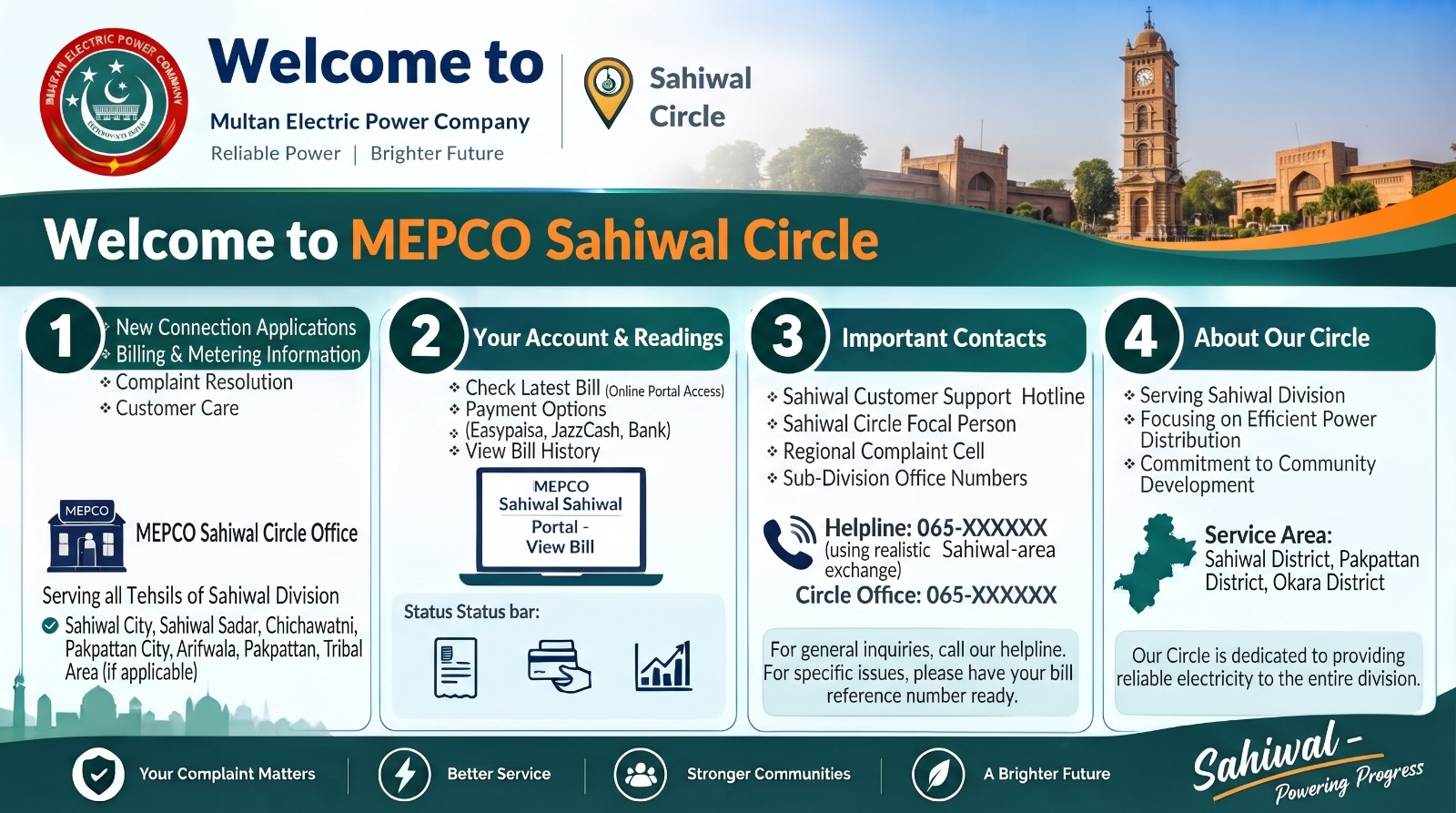
MEPCO organises this area as a full operational circle, not just a single office. The Sahiwal Circle extends beyond the district itself — it also covers Pakpattan district and the Arifwala area, operating through several divisions:
- Sahiwal City Division
- Chichawatni Division
- Pakpattan Division
- Arifwala Division
So if your bill says MEPCO Sahiwal Circle but you live in Pakpattan or Arifwala — that is completely normal. The circle structure does not follow district boundaries one-to-one.
How to Check Your MEPCO Bill Online – Sahiwal 2026
Checking your bill online from Sahiwal is fast and free. Follow these steps:
Tip: If your reference number shows no results, make sure you are not accidentally using a number from a different meter. This is common on properties with more than one connection registered under the same family.
Why Sahiwal’s Agricultural Economy Affects Your Bill
Sahiwal’s economy runs on dairy farming, rice milling, and general agriculture — and a large share of MEPCO connections here reflect that reality. Here is what local consumers need to understand:
Commercial tariffs for small agribusiness.
If you run a rice mill, dairy collection point, or any small agri-processing operation, your connection almost certainly falls under a commercial or industrial tariff — not a residential one. The per-unit rate and slab structure will look very different from a household bill. This is not an error — it is simply how NEPRA tariff categories work.
Tube-well billing in Chichawatni.
Agricultural tube-well connections are billed separately from general use. During peak irrigation season, usage spikes naturally and your bill will go up — this is genuine consumption, not a billing mistake.
Mixed residential-agricultural households.
Many Sahiwal households have both a domestic connection and a separate agricultural connection on the same property. Keeping both reference numbers clearly separate saves a lot of confusion when checking bills or filing complaints.
Common Billing Issues in Sahiwal District
|
Issue |
Who It Affects |
What To Do |
|---|---|---|
|
Confused commercial vs domestic tariff |
Small dairy / agri-business owners |
Check your registered tariff category first |
|
Estimated readings |
Rural Chichawatni villages and chaks |
Submit a correction request with a meter photo |
|
Seasonal tube-well bill spikes |
Farmers during irrigation season |
Compare meter reading against the bill |
|
Duplicate reference numbers on multi-meter properties |
Households with 2+ connections |
Keep both numbers clearly labelled |
|
Paper bill delay in remote areas |
Outer Chichawatni villages |
Check your bill online — charges still apply even without paper delivery |
How to File a Complaint From Sahiwal
The centralized MEPCO CCMS portal covers Sahiwal the same as every other district in the network. A few things worth doing specifically here:
- Mention your tehsil (Sahiwal or Chichawatni) clearly — since the circle covers a broader area, this helps route your complaint faster
- If your complaint involves a commercial or agricultural connection, state the connection type upfront — it affects who reviews the case
- Save your complaint ticket number for any follow-up by phone or in person
Load Shedding in Sahiwal – What to Expect
Urban feeders in Sahiwal city generally see shorter and more predictable load shedding windows compared to rural feeders in Chichawatni and the district’s outer agricultural areas. Rural and agricultural feeders typically carry higher technical losses, which is why NEPRA allows longer management hours on them.
If your outages in a rural part of Chichawatni feel more frequent than a relative’s in the city — this is generally the reason, not a local fault.