MEPCO Bill Multan — Check Online 2026
Multan is where MEPCO operates from. The head office, the computer centre that processes billing data for all 8.5 million consumers across South Punjab, and the largest operational circle in the network all sit here on Khanewal Road. For Multan consumers, this means faster escalation when a complaint genuinely needs head-office attention — but your starting point for any billing issue is still your local subdivision office, not headquarters.
Check Your MEPCO Bill Online — Multan
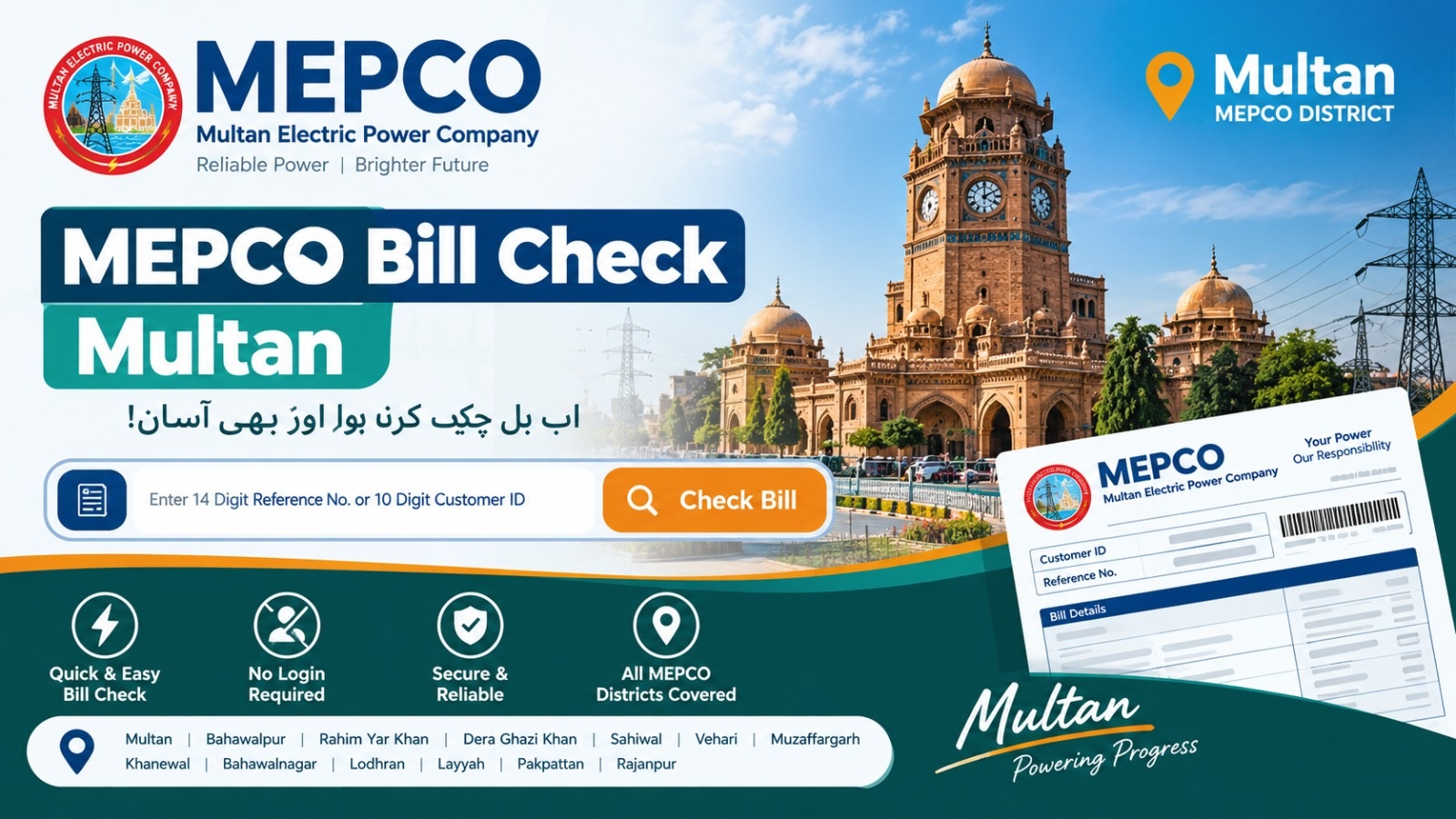
Enter your 14-digit reference number in the bill checker above. Your payable amount, due date, units consumed, meter reading, and last 12 months of payment records load from PITC’s live database within seconds. No login, no registration, no office visit needed.
Multan consumers can also use their 10-digit Customer ID as an alternative to the reference number. Both are printed on your paper bill — reference number at the top right, Customer ID directly below it.
If you moved into a rented property recently and have no previous bill, your landlord or nearest subdivision office can confirm your Customer ID against your CNIC.
Multan District — Areas and Tehsils Covered by MEPCO
|
# |
Tehsil |
Area Type |
Common Connection Type |
|---|---|---|---|
|
1 |
Multan City |
Dense urban |
Domestic and commercial |
|
2 |
Multan Sadar |
Mixed urban |
Domestic, commercial, industrial |
|
3 |
Multan Cantonment |
Cantonment and residential |
Domestic and government |
|
4 |
Jalalpur Pirwala |
Semi-urban and agricultural |
Domestic and tube well |
|
5 |
Shujabad |
Rural and agricultural |
Domestic, tube well, agricultural |
All five tehsils fall under MEPCO’s Multan Circle. Your subdivision office depends on your specific tehsil — calling 118 with your reference number will confirm which subdivision handles your feeder.
MEPCO Multan Office — Address and Contact
|
Service |
Detail |
|---|---|
|
Head Office Address |
MEPCO Complex, Khanewal Road, MEPCO Colony, Multan |
|
Multan Circle Helpline |
061-9220198 |
|
Head Office Main Line |
061-9220313 |
|
Universal DISCO Helpline |
118 |
|
MEPCO Toll-Free |
0800-63726 |
|
WhatsApp Complaint |
0307-7848566 |
For billing complaints specific to Multan, calling 061-9220198 reaches the circle office directly. Use 118 for power outages and urgent faults. Use 0800-63726 for billing queries when the circle office line is busy.
Billing Issues Multan Consumers Face Most Often
Estimated Bills in Older City Areas
In congested parts of Multan city, meter readers occasionally cannot access meters — narrow lanes, locked gates, and shared building access all contribute. When physical reading is not done, MEPCO issues an estimated bill based on your past usage pattern. Estimated readings are flagged on your bill. If your reading looks wrong, photograph your meter display and file a correction request at your subdivision office with the photo as evidence.
Voltage Problems During Summer Peak
Multan’s summer temperatures regularly hit 45 to 48 degrees Celsius from May through August. When the city runs maximum AC load simultaneously, older grid infrastructure — particularly in dense central residential areas — experiences voltage fluctuation. If you are getting persistent low voltage rather than complete outages, report it through 118. Extended low voltage damages AC compressors, refrigerator motors, and water pump motors silently over time.
Agricultural and Tube Well Tariff Mix-Ups
Consumers in Jalalpur Pirwala and Shujabad with tube well connections occasionally find their agricultural meter billed at general commercial or domestic rates rather than the correct agricultural tariff. The two tariff structures are significantly different. Check your bill’s tariff category line — it should clearly show an agricultural designation for tube well meters. If it shows domestic or commercial, raise a correction at your subdivision office.
Protected vs Unprotected Threshold in Summer
A Multan household consuming 180 units comfortably inside the Protected bracket in February can hit 380 to 500 units in June once AC load runs continuously. That single crossing pushes you to Unprotected rates for the next six consecutive months — not just for June. Monitor your mid-month consumption through the PITC portal before your billing cycle closes. A few days of reduced AC use in the final week of a cycle can keep you inside the Protected bracket for that month.
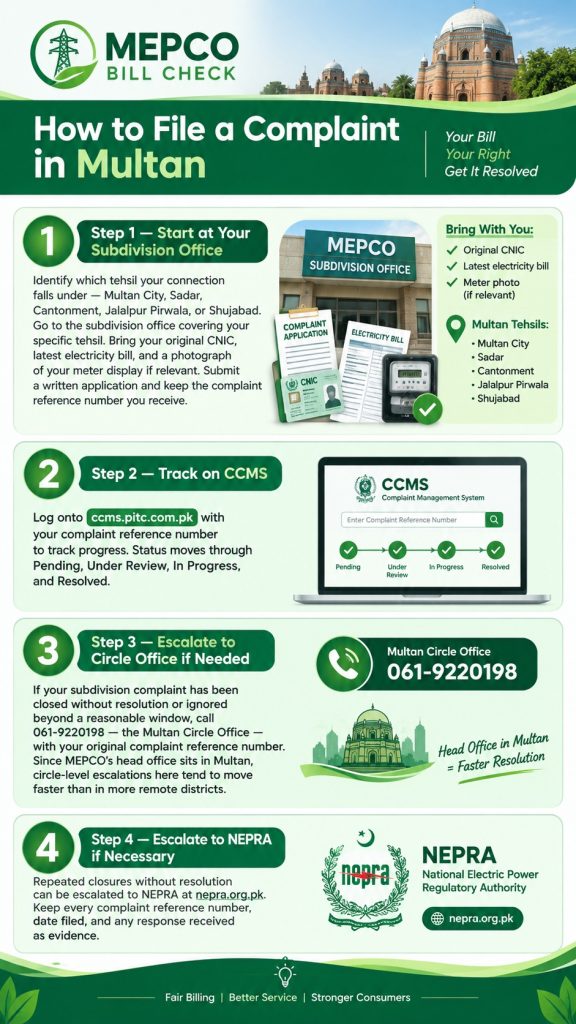
How to File a Complaint in Multan
Step 1 — Start at Your Subdivision Office
Identify which tehsil your connection falls under — Multan City, Sadar, Cantonment, Jalalpur Pirwala, or Shujabad. Go to the subdivision office covering your specific tehsil. Bring your original CNIC, latest electricity bill, and a photograph of your meter display if relevant. Submit a written application and keep the complaint reference number you receive.
Step 2 — Track on CCMS
Log onto ccms.pitc.com.pk with your complaint reference number to track progress. Status moves through Pending, Under Review, In Progress, and Resolved.
Step 3 — Escalate to Circle Office if Needed
If your subdivision complaint has been closed without resolution or ignored beyond a reasonable window, call 061-9220198 — the Multan Circle Office — with your original complaint reference number. Since MEPCO’s head office sits in Multan, circle-level escalations here tend to move faster than in more remote districts.
Step 4 — Escalate to NEPRA if Necessary
Repeated closures without resolution can be escalated to NEPRA at nepra.org.pk. Keep every complaint reference number, date filed, and any response received as evidence.