MEPCO Load Shedding Schedule: How to Check It and Why It Varies by Street, Not by City
If you have ever wondered why your neighbour’s power stays on while yours goes off — or why a “citywide schedule” you found online never matches what actually happens at your house — this guide explains how MEPCO load shedding really works and exactly how to find the schedule that applies to your specific address.
What Is MEPCO Load Shedding? — Quick Answer
MEPCO load shedding is a deliberate, scheduled reduction of electricity supply to specific feeder areas across South Punjab when total grid demand exceeds available supply. It is managed by MEPCO under NEPRA’s load management regulations and operates at feeder level — not at city or district level.
This single fact — that schedules are feeder-based, not city-based — is what most online guides miss entirely, and it is the reason generic “load shedding schedule for Multan today” searches produce results that do not match your street.
Load Shedding vs. Power Outage — Key Differences
These two situations are confused constantly. The distinction matters because the correct response to each is completely different.
|
Load Shedding (Planned) |
Power Outage (Fault) |
|
|---|---|---|
|
What it is |
Deliberate, scheduled supply reduction |
Unplanned failure — transformer, line fault, or overloading |
|
Is it predictable? |
Yes — follows a prepared timetable |
No — occurs without warning |
|
Who decides it? |
MEPCO / NEPRA load management policy |
Caused by infrastructure failure |
|
What should you do? |
Check your feeder schedule |
Report it as a fault immediately |
|
Will it resolve itself? |
Yes — within the scheduled window |
Not necessarily — requires repair |
|
How long does it last? |
Defined window per feeder |
Unpredictable — depends on fault severity |
Key rule: If your power is out well beyond your scheduled load shedding window, that is very likely a fault — not extended load shedding. Report it rather than waiting it out.
Why the Schedule Is Feeder-Based, Not City-Based
This is the most important thing to understand about MEPCO load shedding, and it is the part most people never learn.
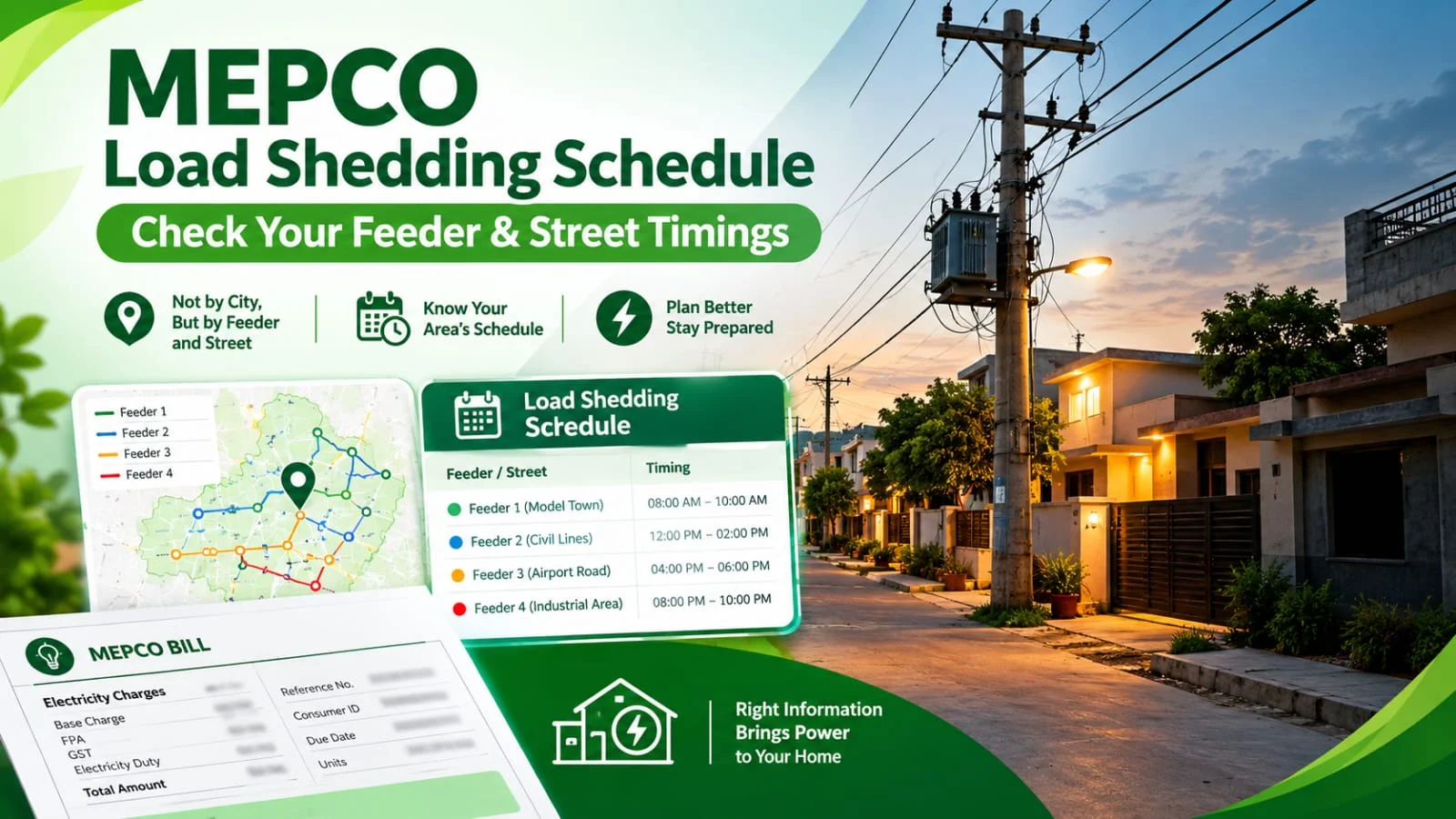
MEPCO’s load shedding schedule does not operate at the level of “Multan” or “Bahawalpur.” It operates at the level of individual feeders — the specific distribution lines serving your immediate street or neighbourhood. Two streets next to each other can be on entirely different feeders with completely different outage timings.
This is precisely why a generic “today’s load shedding schedule for [city]” post found online is often useless for your specific house — it may be describing a feeder that does not serve your address at all.
Why Some Areas Have Longer Load Shedding Than Others
Under NEPRA’s differential load shedding policy, feeder schedules are not assigned arbitrarily. They are influenced by documented factors:
| Factor | Effect on Load Shedding Hours |
| High technical losses on the feeder | Longer assigned load shedding duration |
| Low bill recovery rate in the feeder area | Longer assigned load shedding duration |
| Low technical losses | Shorter assigned load shedding duration |
| Strong bill recovery rate | Shorter assigned load shedding duration |
In practice, this means the exact hours in your neighbourhood can differ noticeably from a nearby one — even within the same city, on the same street in some cases.
Source: NEPRA’s differential load management policy framework — nepra.org.pk
This is not something an individual household can change directly. But understanding it explains why your area’s schedule differs from what a neighbour in a different feeder zone experiences.
How to Check Your Actual MEPCO Feeder Schedule
The only reliable way to find your real load shedding schedule is to check it at feeder level — not by searching for your city name.
| Step | What to Do |
| Step 1 | Locate your 14-digit Reference Number on any recent MEPCO bill |
| Step 2 | Go to the official CCMS feeder details portal — search “CCMS PITC feeder details” and confirm you are on the official government domain |
| Step 3 | Enter your Reference Number to pull up the schedule tied to your specific feeder |
| Step 4 | Note the scheduled window — treat it as your current expected timing, not a permanent fixed schedule |
Important: Feeder schedules change with grid conditions and are subject to revision. The portal gives you the current assigned schedule — recheck it if conditions in your area change significantly.
If the portal is inaccessible: Your local MEPCO Sub-Division Office holds the most current schedule for your feeder and can also advise on any temporary maintenance shutdowns planned for your area — these are separate from routine load shedding and are usually announced in advance.
Planned Maintenance Shutdowns — A Third Category
Beyond routine load shedding and unplanned faults, there is a third category that causes confusion:
|
Type |
Cause |
Notice Given? |
Duration |
|---|---|---|---|
|
Load shedding |
Grid demand exceeds supply |
Yes — scheduled timetable |
Fixed daily window |
|
Maintenance shutdown |
Infrastructure project (pole shifting, line upgrade, new development) |
Yes — specific date, time, reason |
One-off, project-specific |
|
Fault / outage |
Equipment failure |
No — unplanned |
Variable — until repaired |
If you receive a shutdown notice for your area with a specific project reason attached — road widening, distribution line upgrade, housing development — that is a maintenance shutdown, not load shedding. It is unrelated to daily demand management and will not appear on the load shedding schedule.
What to Do When Power Is Out Beyond the Scheduled Window
If your power has not returned after your feeder’s scheduled load shedding window has ended, follow these steps:
|
Step |
Action |
Why It Matters |
|---|---|---|
|
1 |
Recheck your feeder schedule on the CCMS portal |
Confirms the window has actually ended before reporting |
|
2 |
If past the scheduled window — report it as a fault via MEPCO’s official complaint channel |
Unresolved outages need active repair, not waiting |
|
3 |
Have your Reference Number and a landmark description ready |
Speeds up dispatch to the correct technical team |
|
4 |
If you see a downed line, sparking pole, or exposed wiring — report it as a safety emergency immediately |
Safety faults are handled with different urgency than routine outages |
MEPCO Helpline: 118 — free from any mobile or landline network
Reducing Load Shedding Impact on Your Household
|
Action |
Why It Helps |
|---|---|
|
Know your feeder schedule in advance |
Plan water pumping, device charging, and cooking around scheduled windows rather than reacting each time |
|
Unplug sensitive electronics before restoration time |
Voltage fluctuations are more common right as supply returns — protects appliances |
|
Consider a UPS or solar setup |
Addresses the impact directly if outages are long and frequent — worth comparing against the daily cost of lost productivity or spoiled refrigerated goods |
Frequently Asked Questions — MEPCO Load Shedding
Quick Reference — MEPCO Load Shedding Contacts
| Purpose | Contact |
| Fault reporting & general helpline | 118 (free, any network) |
| WhatsApp queries | 0307-7848566 |
| Feeder schedule check | CCMS PITC portal (search “CCMS PITC feeder details”) |
| NEPRA consumer complaint | 080025622 (toll-free) |
| NEPRA online complaint | nepra.org.pk/complaints |
| MEPCO official website | mepco.com.pk |
A Note on This Guide
Every claim in this article is based on:
- Publicly available MEPCO and NEPRA documentation and stated policies
- NEPRA’s published differential load management framework
- General regulatory practice applicable across all Pakistani DISCOs
Load shedding schedules, feeder assignments, and NEPRA policies are subject to change. Always confirm your specific feeder’s current schedule through official MEPCO channels rather than relying on any generic area-wide estimate — including this guide.