MEPCO Bill Bahawalpur — Check Your Electricity Bill Online 2026
Enter your 14-digit reference number or 10-digit Customer ID. Your current bill — payable amount, due date, meter reading, consumed units, and 12-month payment history — loads directly from PITC’s database within seconds. No login, no registration, no office visit required.
Bahawalpur District — Tehsils and Areas Covered
Bahawalpur is one of MEPCO’s five tehsil districts — larger by geographic spread than most other circles in the South Punjab network. Your subdivision office, load shedding schedule, and billing complaint routing all depend on which tehsil your connection is registered in, not just “Bahawalpur” as a general label.
|
# |
Tehsil |
Key Areas |
Consumer Profile |
|---|---|---|---|
|
1 |
Bahawalpur City |
Farid Gate, Model Town, Baghdad ul Jadeed, Cantt, Civil Lines |
Dense residential and commercial load |
|
2 |
Bahawalpur Saddar |
Saddar area, cantonment periphery, newer housing schemes |
Mixed residential, expanding schemes |
|
3 |
Ahmadpur East |
Ahmadpur East city, desert belt areas toward Cholistan |
Agricultural tube wells, rural residential |
|
4 |
Hasilpur |
<cite index=”26-1″>Hasilpur city and 15 union councils — population 506,604 (2023 census)</cite> |
Agricultural dominant, cotton belt |
|
5 |
Khairpur Tamewali |
Khairpur Tamewali town and surrounding union councils |
Rural agricultural, sparse connection density |
Mandi Yazman — frequently searched by Bahawalpur consumers — falls under the Yazman tehsil which is administratively part of the Bahawalpur circle’s divisional coverage. If your connection is in Yazman, your billing and complaint routing go through the same Bahawalpur circle structure.
How to Check Your Bahawalpur MEPCO Bill
Your 14-digit reference number is printed on any previous MEPCO bill in the top section, labelled “REFERENCE NO.” It never changes — the same number works whether your bill is from 2022 or July 2026.
If you moved into a rented property: ask your landlord or the previous tenant for any old bill rather than starting from scratch. The reference number is tied to the meter connection, not the occupant — it carries over to whoever currently lives there.
If you are in rural Hasilpur or Khairpur Tamewali: paper bill delivery to outer tehsils is slower than Bahawalpur city, because physical distribution routes cover significantly more distance per connection. Checking your bill online from the 1st of each month means you know your payable amount and due date before the paper copy arrives — and avoid the 10% Late Payment Surcharge (LPS) that applies regardless of whether the paper bill reached you.
SMS check without internet: type pitc [space] your 14-digit reference number and send to 8334 on Jazz, Zong, Telenor, or Ufone. Works on basic 2G signal. You receive bill amount, due date, and payment status as a text reply.
Agricultural and Tube Well Connections in Bahawalpur — What’s Different on Your Bill
Bahawalpur’s economy runs on cotton, wheat, and sugarcane cultivation across the outer tehsils. A large share of MEPCO’s connections in Ahmadpur East, Hasilpur, and Khairpur Tamewali are agricultural tube well connections — billed under NEPRA’s Agricultural tariff category, not the domestic Protected/Unprotected classification that applies to household connections.
Two billing issues that come up repeatedly for agricultural consumers in Bahawalpur:
Wrong tariff category applied to your connection
If your tube well connection has been reclassified from Agricultural to General/Domestic tariff — sometimes happening during system updates or meter replacement cycles — your per-unit rate changes completely and your bill spikes sharply. This is not a consumption increase; it is a classification error. Check the Consumer Category field on your bill. If it shows “Domestic” or “Commercial” instead of “Agricultural,” file a correction request at your subdivision office immediately with your CNIC, bill, and meter details.
Irrigation season consumption crossing slab thresholds
Peak cotton and wheat irrigation in Bahawalpur’s agricultural calendar runs from approximately April through August. Tube well usage during this period pushes total consumption significantly higher, which can move an agricultural connection into a higher tariff slab under NEPRA’s agricultural rate schedule. This is not a billing error — it is genuine consumption increase driving higher charges. Comparing your April–August bills against November–January bills gives you a baseline for what’s normal versus what warrants a complaint.
Common Billing Problems in Bahawalpur and Their Fixes
|
Problem |
Likely Cause |
What to Do |
|---|---|---|
|
Bill doubled with no consumption change |
Consumer category changed from Protected to Unprotected |
Check Consumer Category field on bill; file correction at subdivision if wrong |
|
Agricultural bill spiked in summer |
Irrigation season pushing consumption into higher slab |
Compare with prior year same month; if reading is correct, it’s genuine usage |
|
Paper bill arrived after due date |
Rural delivery route delays in Hasilpur or Khairpur Tamewali |
Check online from 1st of month; don’t wait for paper copy |
|
Estimated reading on bill |
New housing scheme not yet on established meter reading route |
Submit meter photo with correction request at subdivision |
|
Voltage fluctuation in summer evenings |
Residential AC + agricultural load overlap on mixed feeders |
Register complaint on CCMS at ccms.pitc.com.pk with your reference number |
|
Due date inconsistent month to month |
Rural reading routes don’t land on the exact same day each cycle |
Confirm with subdivision; check online each month rather than relying on paper |
|
Unexpected Bill Adjustment charge |
Correction from a previous billing period |
Check which period the adjustment references; call 118 if reason is unclear |
Load Shedding in Bahawalpur — City vs Rural Feeders
Urban feeders in Bahawalpur city — including areas like Farid Gate, Model Town, Baghdad ul Jadeed, and Civil Lines — carry higher connection density and lower technical loss percentages than rural feeders in Ahmadpur East and Khairpur Tamewali. <cite index=”22-1″>MEPCO divides its operational jurisdiction into 9 distribution operation circles, with Bahawalpur being one of them, branching out into 38 divisions and 181 subdivisions.</cite>
Under NEPRA’s load management framework, feeders with higher Aggregate Technical and Commercial (AT&C) losses are permitted longer outage windows. Outer tehsil feeders in Bahawalpur district — particularly those serving a mix of agricultural load and low-density rural residential — carry higher loss percentages than city core feeders, which is why outage durations in Hasilpur or Khairpur Tamewali are typically longer than in Bahawalpur city even during the same load management period.
If your outage hours seem heavier than a neighbour’s in the city, the feeder classification difference is almost always the reason — not a complaint routing error.
Filing a Complaint as a Bahawalpur Consumer
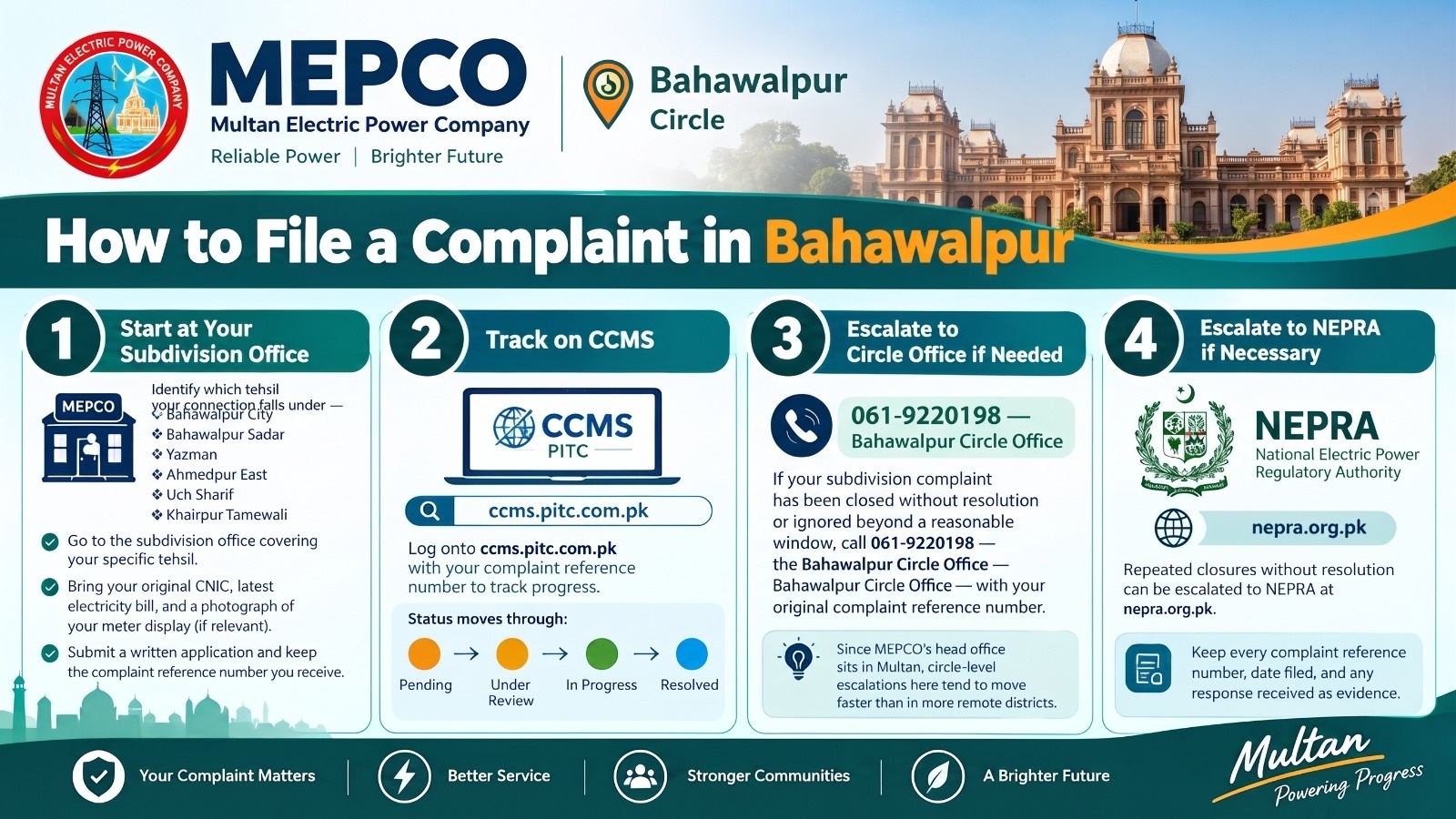
All Bahawalpur complaints — billing, meter, supply, new connection — go through the central CCMS portal at ccms.pitc.com.pk. Once verified with your reference number, your complaint routes automatically to the subdivision covering your registered connection address.
Three things that specifically speed up complaints filed from Bahawalpur district:
Name your tehsil in the description. Bahawalpur district covers five tehsils across a large geographic area. Writing “Ahmadpur East” or “Hasilpur” rather than just “Bahawalpur” helps route your complaint to the correct subdivision faster — vague location details are the most common reason complaints bounce between offices before reaching the right desk.
For agricultural billing disputes, state your connection category upfront. The complaint reviewer needs to know immediately whether you are a residential or agricultural consumer — the billing rules, rate schedules, and correction procedures are completely different. Start your description with “Agricultural tube well connection, reference number XXXX, registered in Hasilpur tehsil” and then describe the issue.
Save your ticket number. Every follow-up — whether by phone at 118, in person at the subdivision, or by email to [email protected] — requires your ticket number. Without it, there is no record for the staff member to pull up.
Bahawalpur Circle helpline: 062-9250102 Universal DISCO helpline: 118 (24/7, all networks) CCMS portal: ccms.pitc.com.pk