MEPCO Bill Correction: How to Fix Wrong Units, Meter Reading & Charges
You can get a wrong MEPCO bill corrected: photograph your meter, compare it with the Present Reading on your bill, file a complaint with your Reference Number, and escalate to NEPRA if MEPCO does not act.
Written by Syeda Mah Para Bashir, SEO Specialist and Content Writer, South Punjab. Based on publicly available MEPCO and NEPRA information. Last reviewed 5 November 2026.
Quick Answer: Which Problem Do You Have?
Find the row that matches what you see on your bill, then follow the first action. The sections below explain each step in detail.
| What you see | Likely cause | First action | Where to go |
| Reading marked EST | Meter was not physically read | Photograph your meter and compare it with the bill | CCMS complaint, then Sub-Division Office |
| Present Reading higher than your meter shows | Misread or mistyped reading | File a reading-correction complaint with your photo | CCMS or Sub-Division Office |
| Units jump with no change in usage | Faulty meter or wrong reading | Request a meter accuracy test in writing | Sub-Division Office |
| Tariff Code does not match your connection | Misclassification | Submit a written reclassification request with documents | Sub-Division Office |
| Paid, but arrears still show | Payment not credited | Bring your bank or wallet receipt | Sub-Division Office |
| A charge you cannot identify | Unrecognised line item | Ask for a written explanation | Sub-Division Office |
| No reply after your complaint | Stalled process | Escalate with your ticket number and stamped application | NEPRA |
Why MEPCO Bills Go Wrong?
Most wrong bills come from a small set of causes, and almost all of them can be checked from your own meter and your own paperwork. Before you file anything, work out which cause matches your bill.
| Cause | What it looks like on your bill | How to confirm |
| Estimated reading (EST) | The reading is marked EST, so the meter was not physically read | Compare the bill’s Present Reading with your meter display |
| Misread or mistyped reading | Present Reading is higher than your meter shows, or lower than the Previous Reading | Photograph the meter and compare both readings |
| Faulty or running-fast meter | Units rise sharply with no change in your appliances or habits | Ask for a meter accuracy test in writing |
| Wrong tariff code | Tariff Code does not match your connection (for example, a tube well not billed as D-1) | Check the Tariff Code field against your connection type |
| Payment not credited | Arrears show an amount you already paid | Keep the bank or wallet receipt as proof |
| Unrecognised charge | A line item you cannot match to a known tax or surcharge | Ask the Sub-Division Office for a written explanation |
A bill that is merely high is not always a wrong bill. In summer, air conditioners can push a household past the 300-unit mark, which changes the slab applied to the whole bill. Rule out genuine usage first, then move to a complaint if the numbers still do not add up.
How to Check Your MEPCO Meter Reading?
Reading your own meter takes about two minutes, and it gives you the single most useful piece of evidence in any billing dispute. Do it as soon as the bill arrives, before the next meter reader visits.
- Find your meter and note the reading shown on the display or dials. Many digital meters cycle through several screens, so wait for the one that shows total energy in kWh.
- Photograph the display clearly, with the date and time visible in the photo details. Take a wider shot too, so the meter’s serial number is in the frame.
- Open your bill and find the Present Reading and Previous Reading fields.
- Compare your photo with the Present Reading. If the two match, the reading is correct and the problem lies elsewhere. If your meter shows a lower figure, you have a documented discrepancy.
- Subtract the Previous Reading from the Present Reading and confirm that the result equals the Units Consumed printed on the bill.
If your meter shows more than one register, for example separate peak and off-peak figures, ask your Sub-Division Office which register your tariff is billed on before you raise a dispute. Comparing the wrong register is a common cause of a complaint that goes nowhere.
Keep a photo of the meter every month, even when the bill looks fine. A run of dated photos is what turns a disputed bill from your word against the record into a documented case.
Worked Example: Finding the Extra Units
The figures below are invented for illustration, not taken from a real bill. They show how a reading error turns into extra units, and how your photo exposes it.
| Item | Figure (kWh) | How it is worked out |
| Previous Reading on the bill | 3,980 | Printed on the bill |
| Present Reading on the bill | 4,560 | Printed on the bill |
| Units billed | 580 | 4,560 minus 3,980 |
| Reading on your meter (your photo) | 4,210 | What the display actually shows |
| Units you actually used | 230 | 4,210 minus 3,980 |
| Extra units billed | 350 | 580 minus 230 |
In this case the dispute is one clear sentence: “My meter shows 4,210, but the bill records 4,560.” Extra units also do more than add to the cost. A higher unit count can move a bill into a higher slab, so a reading error can inflate the amount by more than the extra units alone would suggest.
How to Spot Extra Units and Incorrect Charges?
Run your bill through these checks in order. Each one points to a specific kind of error and tells you what to bring when you complain.
| Check | What to look for | If it fails |
| Units arithmetic | Present Reading minus Previous Reading should equal Units Consumed | Ask for the bill to be recalculated |
| Reading against your meter | Present Reading should match what your meter shows | File a reading-correction complaint with your photo |
| EST marker | Any reading marked EST | Request an actual reading and correction in the next cycle |
| Comparison with past bills | Units far above your usual figure with no new appliances | Look at three previous bills, then request a meter test |
| Billing period | A cycle noticeably longer than your usual one, which inflates units | Ask the office to confirm the billing dates |
| Tariff Code | Code should match your connection (A-1 domestic, A-2 commercial, D-1 tube well) | Submit a written reclassification request |
| Arrears | Any balance you have already paid | Bring the receipt to the Sub-Division Office |
| Taxes and surcharges | Every line should match a known charge such as GST, FPA, Electricity Duty or TV fee | Request a written explanation of any unknown line |
Taxes and surcharges are set by the federal and provincial governments and by NEPRA, not by MEPCO, so they are not negotiable. What you can question is a charge that matches none of them, or a surcharge applied to a connection it should not apply to. For current rates, check your own bill and nepra.org.pk, because tariffs are revised through NEPRA determinations.
Step-by-Step MEPCO Bill Correction Procedure
The correction process works best when you move from the cheapest, fastest route to the most formal one, and keep a record at every stage.
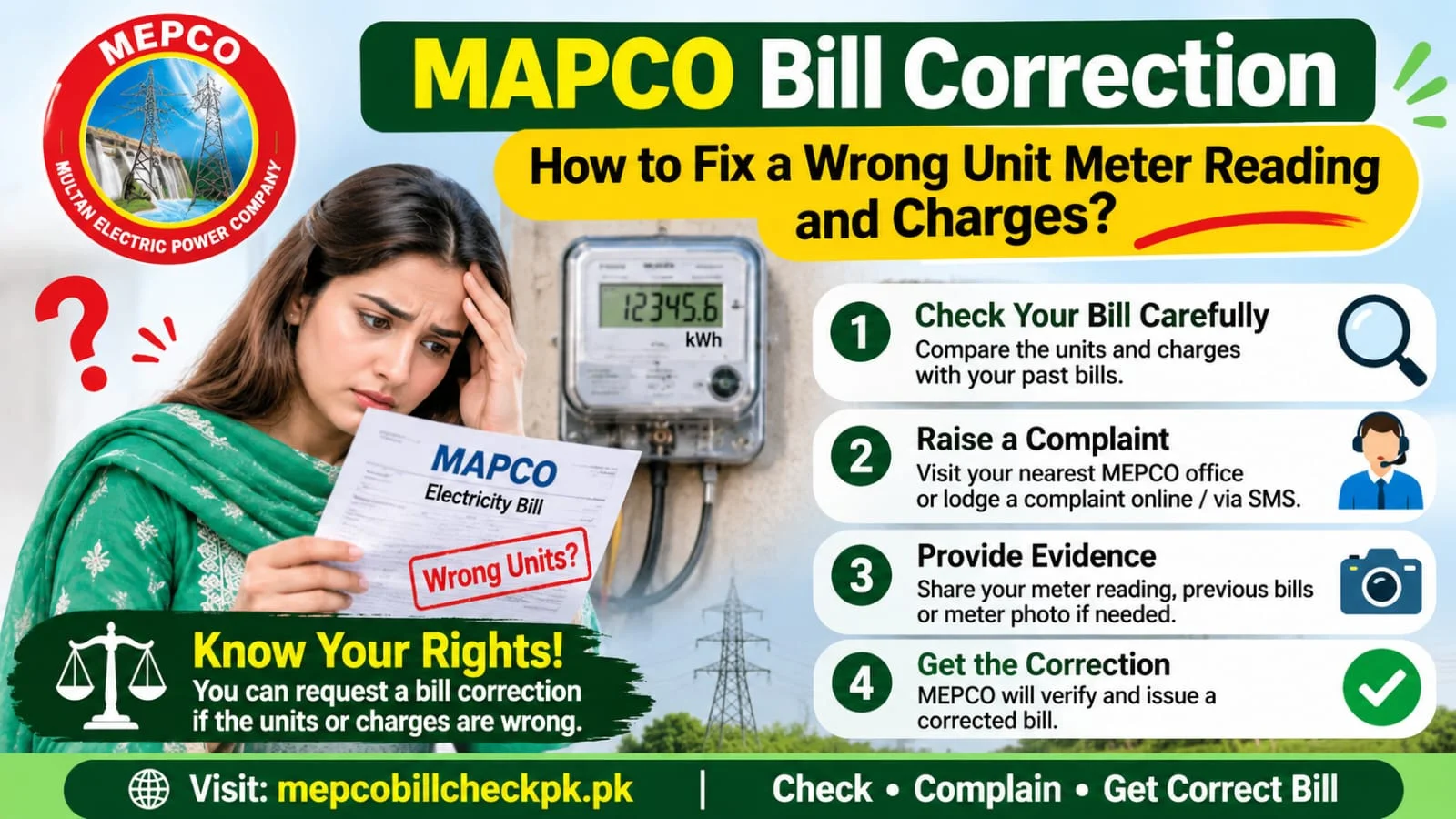
- Confirm the error. Use the meter and bill checks above so you can state the problem in one sentence, for example: “My meter shows 4,210 but the bill records 4,560.”
Gather evidence. Collect the meter photo, the current bill, your last two or three bills, and any payment receipts.
Register a complaint. File it through MEPCO’s complaint channels, quoting your 14-digit Reference Number. The CCMS section below explains how. Write down the complaint or ticket number you are given.
Follow up at the Sub-Division Office. Visit the office that covers your connection with your CNIC, the bill and your evidence. Submit a short written application and ask for an acknowledgement stamp on your own copy.
Ask for the right remedy. Depending on the fault, request a fresh meter reading, a recalculated bill, a tariff reclassification, or a meter accuracy test.
Pay the undisputed part on time. This keeps you clear of late payment surcharge while the complaint is open.
- Check the next bill. Confirm that the correction was applied. If it was not, go back to the office with your ticket number and stamped application.
A simple application is enough. Write your name, Reference Number, address, the figure on your meter, the figure on the bill, and a clear request: “Please verify the reading and correct the bill accordingly.” Sign it, date it, and keep a copy.
Your Complaint Log (Copy and Keep)
A written record of every step is what makes a later escalation easy. Copy this table into your notes and fill in one row each time you contact MEPCO. The first row is an example only.
|
Step |
Date |
Channel |
Ticket or reference number |
What I was told |
Next action |
|---|---|---|---|---|---|
|
Example: reading complaint |
5 Nov |
CCMS portal |
(ticket number shown on screen) |
Complaint registered |
Visit the Sub-Division Office with my photo |
How to Submit a Complaint Through CCMS?
CCMS is MEPCO’s online complaint channel, and its main advantage is that every complaint gets a ticket number you can quote later. Screens and options can change, so treat the steps below as the general flow and follow what the official portal shows.
- Open the complaint section on the official MEPCO website, mepco.com.pk. Do not enter your details on any lookalike site.
- Enter your 14-digit Reference Number, digits only, with no spaces and no trailing letter.
- Choose the complaint category that fits, such as billing or reading, rather than a general one.
- Describe the problem briefly and with figures: your meter reading, the reading on the bill, and the billing month.
- Name your tehsil or area clearly, so the complaint is routed to the right Sub-Division Office.
- Submit, then save the ticket number as a screenshot and in your notes.
Use the ticket number whenever you follow up, whether by phone or in person at the office. If the portal is down or you prefer a person-to-person route, the Sub-Division Office accepts a written application, and that stamped copy carries the same weight as a ticket.
For related problems, see our guides on duplicate bills, MEPCO arrears and the CCMS complaint process.
Documents Required for Bill Correction
Bring the documents below to the Sub-Division Office. Requirements can vary by office and by the type of complaint, so confirm the list when you call or visit.
| Document | Why it is needed | Needed for |
| Original CNIC and one photocopy | Confirms you are the registered consumer | Every complaint |
| Current bill, original or clear printout | Shows the disputed reading, units and charges | Every complaint |
| Previous two or three bills | Shows your normal consumption pattern | Unit and reading disputes |
| Meter photograph with date and time | Your evidence of the actual reading | Reading and EST disputes |
| Bank or wallet payment receipts | Proves a payment that is missing from arrears | Arrears disputes |
| Land record (Fard Malkiat) and Khasra number | Proves an agricultural connection | Tube well tariff reclassification |
| Written application with your copy stamped | Proves the complaint was formally received | Every complaint |
Keep every original receipt and stamped copy until the correction appears on a bill. If a document is lost, a photo or screenshot kept on your phone is far better than nothing.
Paying While Disputed, and When to Contact NEPRA
Pay the part of the bill you accept before the due date, even while a complaint is open. Holding back the whole bill does not stop late payment surcharge, and unpaid balances can lead to a disconnection notice. Work out the amount you believe is correct from your own meter reading, pay that, and keep the receipt. If the complaint succeeds, the difference is adjusted in a later bill.
NEPRA regulates MEPCO and the other distribution companies, and it is your next step when MEPCO has not resolved a complaint. Use it after you have gone through MEPCO first, not instead of it.
| Situation | What to do |
| MEPCO has not responded to your written complaint after a reasonable time | Escalate to NEPRA with your ticket number and stamped application |
| The office refuses a meter test or a reading correction without a reason | Escalate and attach your evidence |
| A correction was promised but not applied on the next bill | Go back to the office first, then escalate if it still does not move |
| A disconnection notice arrives while your complaint is pending | Pay the undisputed amount, then escalate with proof of the open complaint |
File a NEPRA complaint through the consumer complaint section at nepra.org.pk, where you will also find the current contact details. Attach your Reference Number, the dates of each step you have taken, and copies of your evidence. A complaint that shows a clear paper trail is easier to act on than one that only describes the frustration.
Who Handles What?: Sub-Division Office, CCMS and NEPRA
Each channel has a different job, and using the right one first saves weeks.
| Channel | Best for | Bring or quote | Keep as proof |
| CCMS portal | Registering a billing or reading complaint quickly | 14-digit Reference Number, both reading figures | Ticket number and a screenshot |
| Sub-Division Office | Formal written complaints, meter tests, tariff reclassification | CNIC, current and past bills, meter photo | Your application copy with the office stamp |
| NEPRA | Escalating a complaint MEPCO has not resolved | Reference Number, ticket number, dates of each step, evidence | Your NEPRA complaint acknowledgement |
Frequently Asked Questions
Final Words
A wrong MEPCO bill is usually fixable, and the people who get it fixed are the ones who arrive with a photo, a receipt and a ticket number. Check your meter, rule out genuine usage, complain in writing, pay the undisputed part on time, and escalate to NEPRA only if the first steps stall.
Phone numbers, fees and portal screens change over time, so confirm them on mepco.com.pk and nepra.org.pk before you act.